Featuring his songs, Arizona historical research, and scheduled appearances
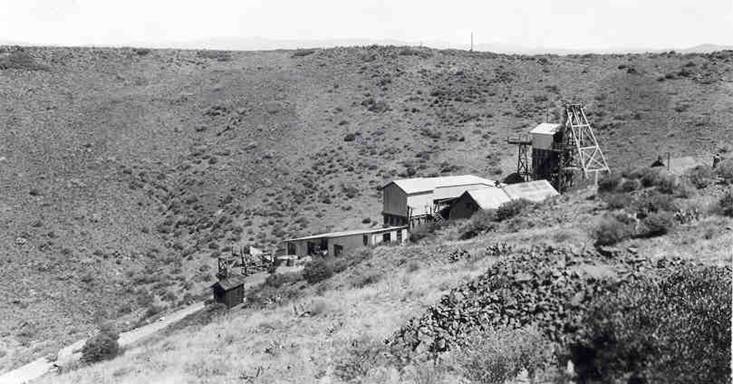
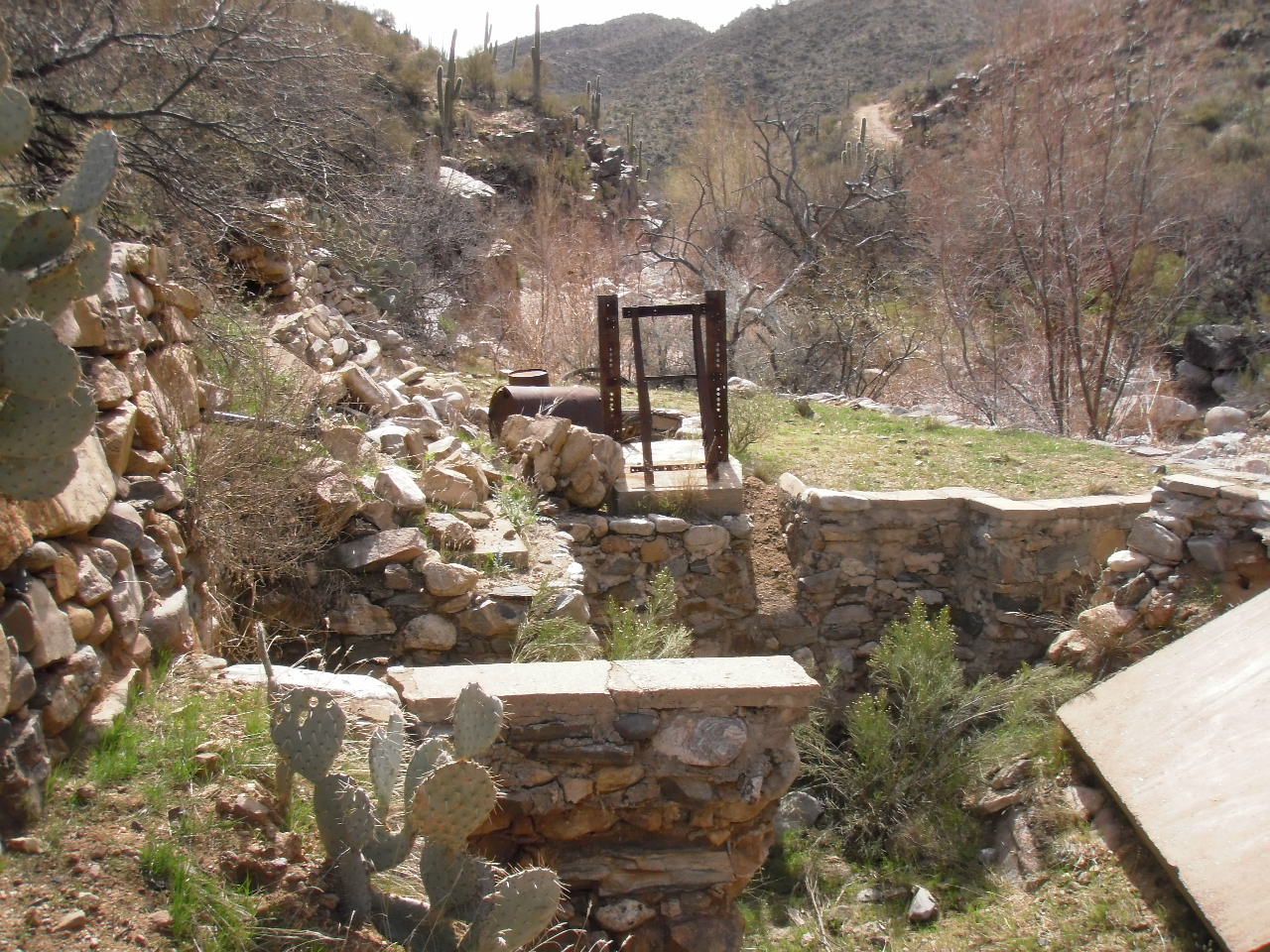
Richinbar Mine
Richinbar Mine - Photo from 1940 - Courtesy of Arizona Geologic Survey files
Thursday, May 5, 2011
Single Jack Miner
According to Frank Crampton, in his book "Deep Enough" 1982 University of Oklahoma Press, "After mucking came instruction in single and double-jack drilling. Usually hard rock stiffs could work double or single as they chose....Double jacking was impossible in narrow stopes less than sixteen to eighteen inches wide, where the holes to be drilled were mostly overhead anyway...They taught me how to point drill holes, and why; and to drill without going-by and breaking my hand, if the single jack missed the steel drillhead. Pointing each drill hole was damned important. Swinging the ordinary four-pound single jack fifty times a minute, for hours at a time was bad enough, but John T trained me on what he called a "Dago" which weighed four and one-half pounds and had a tapered face smaller than the regular single jack hammer head. The fewer holes one had to drill, the less work there was to do: drilling with the "Dago" and pointing holes so that each would break out the most rock was the answer."
Experienced single jack miners struck the drill approximately 50 times per minute, while rotating the drill a 1/4 turn between hammer strikes.
Photo provided by LunaCommon.org - UCR California Museum of Photography
Thursday, April 14, 2011
Walnut Grove - 1890
According the State of Arizona 2009 Multi-Hazard Mitigation Plan,
"February 22, 1890, the most significant dam failure experienced in the State occurred in Walnut Grove. The dam failed due to overtopping and the ensuing flood caused an estimated 150 deaths and extensive destruction of property. The failure was blamed on inadequate capacity of the spillway and poor construction. Located 30 miles by river north of Wickenburg on the Hassayampa River, the dam was built to provide water for irrigation and gold placer mining. The rock fill structure was 110 feet high, 400 feet long, had a base width of 140 feet, a top width of 10 feet, and a spillway of 5-20 feet long. The lake was 2.5 miles long by one mile wide covering over 1,000 acres, an average depth of 60 feet. Based upon various accounts of the Walnut Grove Dam failure, the weather at the time was rain and melting snow. The day before the breach, water in the lake rose rapidly at the rate of about one and one-half foot per hour. The spillway was enlarged to allow excess water to escape but the effort was insufficient to stop water from running over the top. A sheet of water three feet thick reportedly poured over the dam top for six hours. Between 1:00 - 2:00 A.M. on February 22, 1890 the dam broke and the lake drained in one to two hours. The water rushed down Box Canyon, a narrow, steep canyon in a body 80 feet high. Floodwaters reached Wickenburg, 30 miles downstream in two hours and was reportedly still in a column 40 feet high."
I invite you to read "Arizona's Worst Disaster - The Hassayampa Story - 1886-2009" by Jim Liggett. Copies are available at the Desert Caballeros Western Museum in Wickenburg, Arizona.
Two important men were directly involved in the incident:
W.O. "Buckey" O'Neill, the Yavapai County Sheriff, is a legendary historic figure who went on to serve with Theodore Roosevelt's Rough Riders. Read "Rough Rider: Bucky O'Neill of Arizona" by Dale L. Walker for more information about O'Neill's important role in Arizona history.
Alexander Brodie was employed as the superintendent of the Walnut Grove Dam. Brodie went on to serve with Theodore Roosevelt's Rough Riders, and as Territorial Governor of Arizona from 1902 to 1905.
All images are used by permission of the Arizona Pioneer & Cemetery Research Project. The song is copyrighted by Robert T. Gibney 2011.
Jack Swilling died in Yuma County Jail on August 12, 1878 after being arrested for a crime that he did not commit. He was a leading figure in the early days of the Arizona Territory: He served in Arizona for the Confederate Army during the Civil War, he led and protected many groups who traveled across the southwest, he was an original settler in the Salt River Valley, he formed a company that developed the first irrigation canal in the modern era for agriculture in the Salt River Valley, and he was a leader in prospecting and developing new mining claims and mining communities.
This music expresses the thoughts and emotions expressed in his last letter:
To the public
Jack Swilling whose doors have been open to the poor alike with those of the rich and plenty, looks forth from the prison cell to the blue heavens where reigns the Supreme Being who will judge of my innocence of the crime which has been brought against me by adventurers and unprincipled reward hunters. I have no remorse of conscience for anything I have ever done while in my sane mind. In 1854 I was struck on the head with a heavy revolver and my skull broken, and was also shot in the left side, and to the present carry the bullet in my body. No one knows what I have suffered from these wounds. At times they render me almost crazy. Doctors prescribed years ago, morphine, which seemed to give relief, but the use of which, together with strong drink, has at times as I have been informed by my noble wife and good friends made me mad and during these spells I have been cruel to here, at all other times I have been a kind husband. During these periods of debauch, caused by the mixture of morphine and liquor, I have insulted my best friends, but never when I was Jack Swilling, free from these poisonous influences. I have tried hard to cure myself of the growing appetite for morphine, but the craving of it was greater than my will could resist. I have gone to the rescue of my fellowmen when they were surrounded by Indians. I have given to those who needed. I have furnished shelter to the sick. From the Governors down to the lowest Mexican in the land have I extended my hospitality, and oh, my God, how I am paid for it all. Thrown in prison, accused of a crime I would rather suffer crucifixion than commit.
Taken from my wife and children, who are left out in the cold, cold world all alone. Is this my reward for the kindness I have done to my fellowman, and the pay I must receive for having done a Christian act with Munroe and Kirby, that of going after the bones of my poor friend snively and taking them to Gillett and burying them by the side of my dear child. George Munroe, Andy Kirby, and myself are as innocent of the charge brought against us of robbery as an infant babe. We went out to do a Christian act.
Oh God, is it possible that poor old Jack Swilling should be accused of such a crime? But the trouble has been brought on by crazy, drunken talk. I was willing to give up my life to save Munroe and Kirby, as God knows they are innocent. Oh, think of my poor babies and you would know that I would not leave them for millions of money. I am persecuted and prosecuted and prosecuted until I can bear it no longer. Look at me and look at them. This cruel charge has brought me for the first time in my life under a jailer's key. Poor L.G. Taylor, who I liked and tried to help, has been one of those who has wrought my ruin, and for what I cannot conceive, unless it was for reward money or to rob my family of the old ranch. The reason I write this is because I may be found dead any morning in my cell. I may drop off same as poor Tom McWilliams did at Fort Goodwin. My persecutors will remember me. And may God help my poor family through this cold world, is my prayer.
Read more details about Jack Swilling at:
http://www.apcrp.org/SWILLING_Jack.htm
All images are used by permission of the Arizona Pioneer & Cemetery Research Project. The song is copyrighted by Robert T. Gibney 2011.
This is my new song based on the story of Justice Reynolds and Andres Bustamente described in my last blog post. I hope that you enjoy it. Feel free to leave comments on the blog.
Here is a story that needs telling - A drifter murders a justice of peace in a Crown King saloon in 1904. The Territorial Governor contributes $250 reward money in addition to $100 from the county sheriff. The story captured the attention of the entire state with news stories printed from Bisbee to Flagstaff. The accused murderer eludes capture for 9 days and then severely beats one of the three deputies who attempt to capture him while he slept.
According to the Bisbee Daily Review, "Justice Killed Near Prescott...Posse Surrounds Murderer and Will Close in This Morning...Judge Reynolds Was Widely Known in the Territory - Was Shot Through the Heart By Mexican Because of Woman". This information is based on the story as report in the Coconino Sun, Arizona Silver Belt, and the Bisbee Daily Review.
Here are the facts as reported:
Justice Reynolds was 60 years old. He was in Crown King on official business, but he spent the much of the day on September 10, 1904 in the local saloon. He spent part of the day drinking and quarreling with Andres Bustamente, a 25-year old man from Mexico. They argued several times about a beautiful Mexican woman. Bustamente may have been a mine worker, or a drifter who frequented the local saloons. After shooting and killing Reynolds, Bustamente "sauntered into another saloon", but quickly left. "Bustamente is said to have a bad reputation and the Mexicans throughout the area are afraid of him".
A $100 reward was offered by the County Sheriff and a $250 reward was offered by Governor Brodie of the Arizona Territory. Bustamente was described as 5'10" and 150 pounds with a scar from a bullet wound on the right side of his neck. Sheriff Roberts led a posse of twenty men in search of Bustamente after the shooting. A miner by the name of Dennis Welsh encountered Bustamente on September 16th near Hot Springs Junction and reported him to the Sheriff. "Bustamente was captured this morning (Sept 19) after a hard fight with three officers. He was tracked to the house of a woman in Columbia (Near Humbug) by three of Sheriff Roberts' deputies and surprised while asleep. As soon as awakened Bustamente got his rifle and before Deputy Mike Welch could defend himself he had been struck two vicious blows over the head, falling to the floor in a senseless condition. The other two deputies closed in on the Mexican, and by beating him severely with revolvers were able to handcuff his wrists."
"Bustamente, charged with the murder of Judge Reynolds at Crown King was yesterday lodged in the county jail. His passage from the depot to the jail was thronged with curious people, fully 100 following him to the portals, from where he may emerge to the scaffold. He appeared to take a keen delight at the notoriety he was receiving and expressed his satisfaction with a broad grin."
My song will explore the ambiguity of the situation: Why did Justice Reynolds spend the day with Bustamente? Was the woman who was the subject of their arguments the same woman who was with Bustamente the day that he was arrested? Was Bustamente protecting Maria in the only way that he knew? While all of the news accounts focused on the "Mexican" no one talked about Reynolds.
These two powerful men collided during a violent period in Arizona history. While Bustamente led a short and violent life, Justice Reynolds may have had a more colorful life than first appears.
Look for my song to be posted on this blog in the coming days.
The public was invited to the Humbug Open House on March 3rd, sponsored by Dave Burns, Neal Du Shane, and the Arizona Pioneer and Cemetery Research Project. This is an annual event that offers a rare view of one of Arizona's best-preserved ghost towns. Dave led several groups through a tour of the original home-site of Charles Champie, the original smelter, the home of Frank Hyde, the cemetery, and mill. You can read more about the history of Humbug by referring to this link History of Humbug.
Neal led our caravan of vehicles about 10 miles north of Lake Pleasant on Saturday morning. The route passed through several gates that were unlocked for the open house. Small group tours were offered to the Columbia and El Paro Bonito mines. At its peak, approximately 200 people lived at Humbug. The current owners are working to preserve the remaining structures, while providing the public with an opportunity to enjoy a day learning about one of Arizona's unique ghost towns.
This is an updated version of The Richinbar Mine:
- Added a final verse
The miners all left without telling their story.
A few men are buried, the end of the line.
If you go, say a prayer for the miners and families
Their memories live at the Richinbar Mine
- Added historical photos courtesy of the Arizona Pioneer and Cemetery Research Project and the Sharlot Hall Museum
- New musical arrangement
Please post your comments to provide me with your feedback about the song. Bookmark my blog and check back to see new posts about Arizona history, mining, hiking, and music.