Richinbar Mine
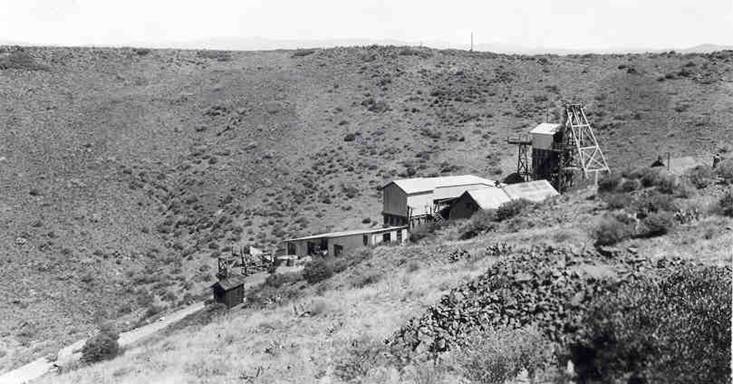
Richinbar Mine - Photo from 1940 - Courtesy of Arizona Geologic Survey files
Tuesday, June 18, 2013
California As It Is And Was - Lyrics by John A. Stone ("Old Put") Musical Setting and Performance by Robert T. Gibney
This song relates many of the experience of the placer miners during the last years of California's Gold Rush. The narrator reminisces about the simpler days of 1849-50. He laments the coming of the railroad, competition from Chinese laborers, the high price of food, the imposition of taxes, and the political corruption of the time. The song was published in "Put's Original California Songster" - D.E. Appleton & Co. 1855


Friday, June 14, 2013
PUT'S ORIGINAL CALIFORNIA SONGSTER
1855 5TH EDITION 25TH THOUSAND
This is a rare copy of the leading songbook of the California Gold Rush as written by John A. Stone, using the pseudonym "Old Put". I am posting the publishing information and Preface so that the author speaks for himself. This volume demonstrates how the leading professional song writer of the era marketed his songsters to a growing audience. He set his lyrics to melodies of popular songs and priced his songsters at a low price to appeal to a popular audience. Many of his songs have achieved "folk song" status. It is important to recognize the importance of John A. Stone ("Old Put") as the source of many of the West's most enduring songs.
 "Giving in a few words what would occupy volumes, detailing the hopes, trials and joys of a miner's life"
Published by D.E. Appleton & Co, 508-510 Montgomery St., San Francisco
Entered according to Act of Congress, in the year 1854 by John A. Stone
Preface
"In dedicating this little Book of Songs to the Miners of California, those hardy builders of California's prosperity and greatness, the author deems it his duty to offer a prefatory remark in regard to the origin of the work and the motive of its publication.
Having been a miner himself for a number of years, he has had ample opportunities of observing, as he has equally shared, the many trials and hardships to which his brethren of the pick and shovel have been exposed, and to which in general they have so patiently, so cheerfully, and even heroically submitted. Hence, ever since the time of his crossing the Plains, in the memorable year of '50, he has been in the habit of noting down a few of the leading items of his experience, and clothing them in the garb of humorous, though not irreverent verse.
Many of his songs may show some hard edges, and he is free to confess, that they may fail to please the more aristocratic portion of the community, who hav but little sympathy with the details, hopes, trials, or joys of the toiling miner's life; but he is confident that the class he addresses will not find them exaggerated, nothing extenuated, nor aught set down "in malice".
In conclusing, he would state, that after having sung them himself at various times and places, and latterly with the assistance of a few gentlemen, known by the name of Sierra Nevada Rangers, the songs have been published at the request of a number of friends; and if the author should thereby succeed in contributing to the amusement of those he is anxious to please, enlivening the long tedious hours of a miner's winter fireside, his pains will not be unrewarded." - San Francisco, Sept., 1855
"Giving in a few words what would occupy volumes, detailing the hopes, trials and joys of a miner's life"
Published by D.E. Appleton & Co, 508-510 Montgomery St., San Francisco
Entered according to Act of Congress, in the year 1854 by John A. Stone
Preface
"In dedicating this little Book of Songs to the Miners of California, those hardy builders of California's prosperity and greatness, the author deems it his duty to offer a prefatory remark in regard to the origin of the work and the motive of its publication.
Having been a miner himself for a number of years, he has had ample opportunities of observing, as he has equally shared, the many trials and hardships to which his brethren of the pick and shovel have been exposed, and to which in general they have so patiently, so cheerfully, and even heroically submitted. Hence, ever since the time of his crossing the Plains, in the memorable year of '50, he has been in the habit of noting down a few of the leading items of his experience, and clothing them in the garb of humorous, though not irreverent verse.
Many of his songs may show some hard edges, and he is free to confess, that they may fail to please the more aristocratic portion of the community, who hav but little sympathy with the details, hopes, trials, or joys of the toiling miner's life; but he is confident that the class he addresses will not find them exaggerated, nothing extenuated, nor aught set down "in malice".
In conclusing, he would state, that after having sung them himself at various times and places, and latterly with the assistance of a few gentlemen, known by the name of Sierra Nevada Rangers, the songs have been published at the request of a number of friends; and if the author should thereby succeed in contributing to the amusement of those he is anxious to please, enlivening the long tedious hours of a miner's winter fireside, his pains will not be unrewarded." - San Francisco, Sept., 1855

Wednesday, January 16, 2013
War To The Death - TrueWest Magazine Article
Here is a link to my article that appears in the February edition of TrueWest Magazine. it is about the life and times of William Porter Jones.
http://www.truewestmagazine.com/jcontent/history/history/history-features/4879-war-to-the-death
Will Jones was a young man who left his family in southern Missouri in 1858 to search for gold in the Western Territories. He worked as a placer miner in many of the well known mining camps: Pike's Peak, Colorado; Grass Valley, California; Aurora, Nevada; Hassayampa River, Lynx Creek, Big Bug Creek Arizona from 1859 to 1864.
This is a photo of Joseph Walker, the famous trapper and guide who led the first party of Pioneers to the Prescott area in 1863. Jones encountered the Walker Party in the fall of 1863, after his trek from Aurora, Nevada. Jones worked placer mining claims along the Hassayampa River, Lynx Creek, and Big Bug Creek. He was associated with some of the important leaders of the era: J.T. Alsap, Theodore Boggs, King Woolsey, etc.
The fascinating story of William Jones is included in a collection of nine letters that were donated by his family to the Sharlot Hall Museum.
This is a link to the letters on the Arizona Memory Collection:http://azmemory.azlibrary.gov/cdm/compoundobject/collection/shmwpj/id/71/rec/36


Tuesday, January 8, 2013
150th Anniversary of the Arizona Territory
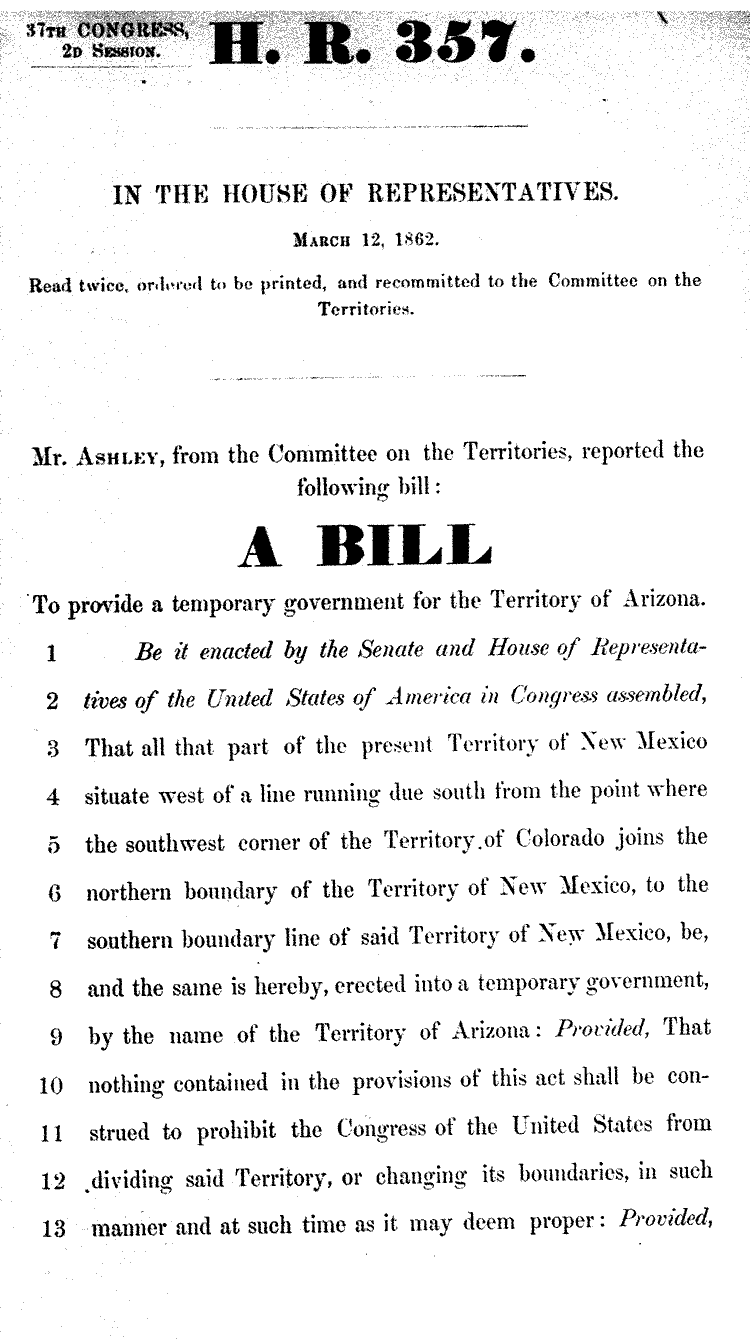
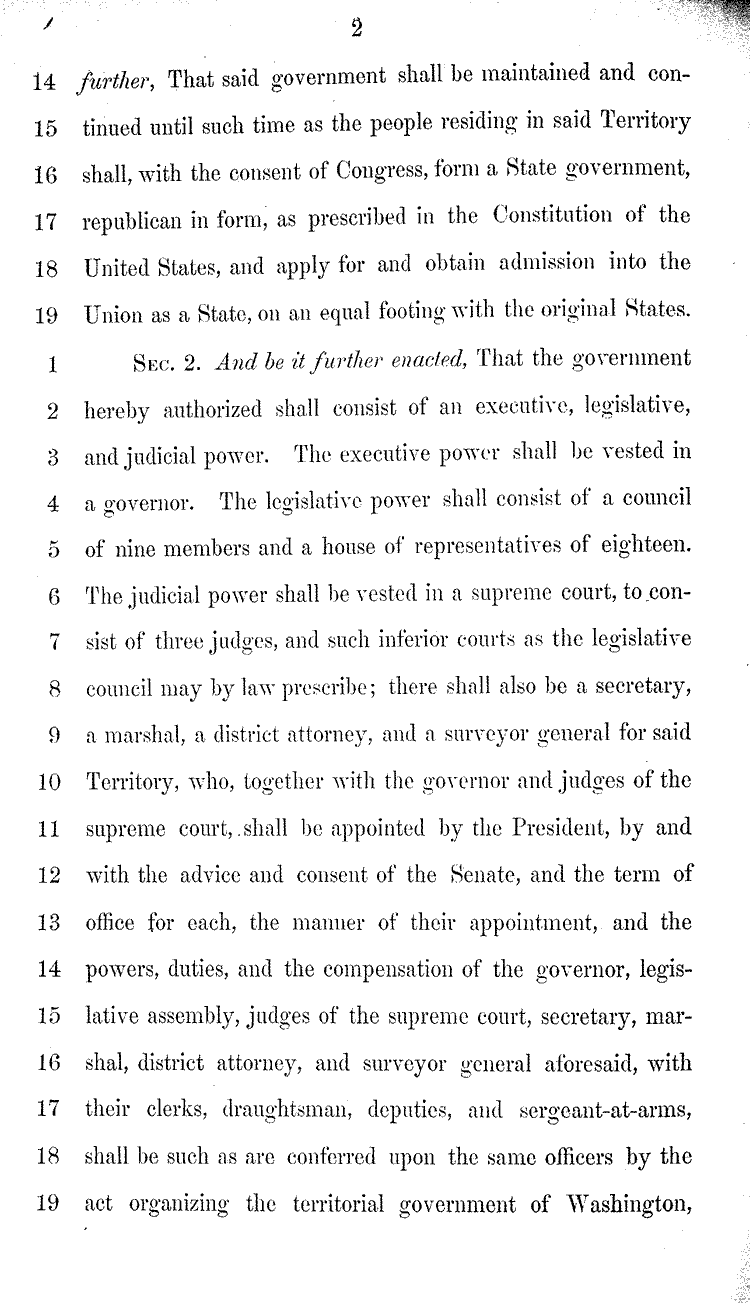
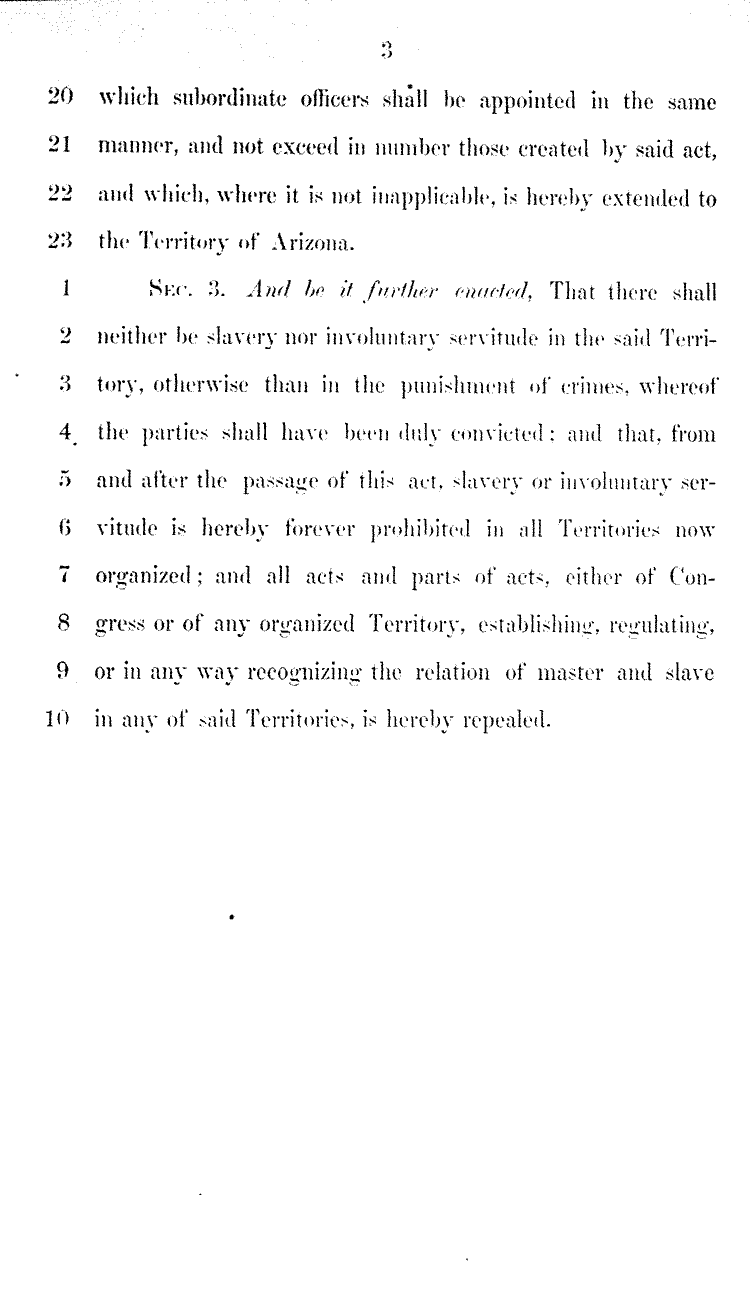
I am continuing to research the Territorial history of Arizona. February 2013 marks the 150th Anniversary of the formation of the Arizona Territory. The Arizona Territory was formed in the midst of the Civil War. The South claimed the southern portion of Arizona as part of the Confederacy. President Lincoln signed this bill into law on February 24, 1863. Prescott was chosen as the original Territorial Capital, despite the fact that Tucson was a more established town. Tucson was located in the disputed portion of the Territory.
Here is a link to the Library of Congress:
http://lcweb2.loc.gov/cgi-bin/ampage?collId=llhb&fileName=037/llhb037.db&recNum=1985


Tuesday, December 11, 2012
Original Phoenix Townsite Map
 Thomas Edwin Farish's 8-volume History of Arizona was published between 1915 and 1918. Volume 6 describes the early days of the Salt River Valley and the formation and development of the Phoenix townsite. "When the commissioners appointed by the Salt River Valley Association received their instructions, they employed in the month of November, Captain Wm. A. Hancock to survey and plan the townsite upon the half section selected for that purpose, and by the 23rd of December, 1870, a sufficient number of lots had been surveyed to enable the Town Commissioners to hold a sale and so procure funds enough to prosecute the work of surveying. This work was necessarily slow, and frequently lagged for the want of funds, as money was very scarce, but by Autumn of 1871, the last lot had been surveyed and the Hancock map furnished, showing a town site one mile in length by half a mile in width, divided into ninety-eight blocks. These city founders laid out the original townsite of Phoenix so as to provide for a large and populous city in the future. Washington, the main street running east and west, was one hundred feet wide, as was also Jefferson, the first parallel street to the south, and Center, the principal cross street, while all other streets were made with a width of 80 feet. With few exceptions blocks were laid out three hundred feet long, 12 lots, 50x137½ feet each, to the block, with a 25 foot alley running through most of the squares.
The first lot sold was that on the southwest corner of Washington and Montezuma (now First) streets. It was bought by Judge William J. Berry of Prescott, for $104, while the adjoining lot to the south brought $40. The opposite corner, where Berryhill's store is now located, was sold to Captain Hancock for $70. It was resold to Ellis & Company a few years later for $8,000. The two lots first mentioned, Nos. 1 and 2 in Block 22, which at one time also belonged to George D. Kendall, an early contractor and carpenter, are to-day covered by a portion of what is called the Irvine Block, built in 1879, by Edward Irvine, an early resident of this city, but lately deceased, while upon the Hancock lot, No. 2 in Block 21, on the opposite side of Washington street, was erected in 1889 the Anderson Building, which is now occupied by the Berryhill Stationery Store and the Baswitz Cigar Company."
Thanks to Brad Hall for posting a copy of the Phoenix Townsite map. I posted the location and description of some of the first buildings constructed in Phoenix.
According to Farish, "At this time [1870's] all the buildings were of adobe. Lumber was exceedingly scarce and expensive, the little reaching the valley coming from Prescott."
Thomas Edwin Farish's 8-volume History of Arizona was published between 1915 and 1918. Volume 6 describes the early days of the Salt River Valley and the formation and development of the Phoenix townsite. "When the commissioners appointed by the Salt River Valley Association received their instructions, they employed in the month of November, Captain Wm. A. Hancock to survey and plan the townsite upon the half section selected for that purpose, and by the 23rd of December, 1870, a sufficient number of lots had been surveyed to enable the Town Commissioners to hold a sale and so procure funds enough to prosecute the work of surveying. This work was necessarily slow, and frequently lagged for the want of funds, as money was very scarce, but by Autumn of 1871, the last lot had been surveyed and the Hancock map furnished, showing a town site one mile in length by half a mile in width, divided into ninety-eight blocks. These city founders laid out the original townsite of Phoenix so as to provide for a large and populous city in the future. Washington, the main street running east and west, was one hundred feet wide, as was also Jefferson, the first parallel street to the south, and Center, the principal cross street, while all other streets were made with a width of 80 feet. With few exceptions blocks were laid out three hundred feet long, 12 lots, 50x137½ feet each, to the block, with a 25 foot alley running through most of the squares.
The first lot sold was that on the southwest corner of Washington and Montezuma (now First) streets. It was bought by Judge William J. Berry of Prescott, for $104, while the adjoining lot to the south brought $40. The opposite corner, where Berryhill's store is now located, was sold to Captain Hancock for $70. It was resold to Ellis & Company a few years later for $8,000. The two lots first mentioned, Nos. 1 and 2 in Block 22, which at one time also belonged to George D. Kendall, an early contractor and carpenter, are to-day covered by a portion of what is called the Irvine Block, built in 1879, by Edward Irvine, an early resident of this city, but lately deceased, while upon the Hancock lot, No. 2 in Block 21, on the opposite side of Washington street, was erected in 1889 the Anderson Building, which is now occupied by the Berryhill Stationery Store and the Baswitz Cigar Company."
Thanks to Brad Hall for posting a copy of the Phoenix Townsite map. I posted the location and description of some of the first buildings constructed in Phoenix.
According to Farish, "At this time [1870's] all the buildings were of adobe. Lumber was exceedingly scarce and expensive, the little reaching the valley coming from Prescott."

Thursday, November 29, 2012
Scheduled Appearance Update and New Article in True West Magazine
I am scheduled to perform my original songs and stories at the Rustic Cafe on this Saturday night:
Dec 8 - 6:00 - 6:30 Rustic Cafe - 20811 N Cave Creek Road, Phoenix (2 blocks north of 101)
I will be performing several new songs. My newest song (The Mexican Outlaws) is in memory of Nicholas Ivie, the US Border Patrol Officer who died on Oct 2 near the town of Naco, Arizona. Another song (The Ballad of the Rocking AD) is inspired by the work of Allen Dutton, the muti-talented artist who has written about and photographed many of Arizona's historic locations. Mr. Dutton's good humor and intellectual curiosity has inspired the creative spirit of all his work: photographs, painting, writing, sculpture, and teaching.
I am pleased to announce that True West Magazine will be publishing my article about the life of William Porter Jones, a young man who left his family in rural Missouri to search for gold in the western mining camps from 1858 to 1864. His collection of letters were preserved by his family and donated to the Sharlot Hall Archives. The letters tell the tale of a prospector who maintained his good humor and optimism, despite the danger and financial risks that he faced in his chosen occupation. William Jones' journey took him from Pike's Peak Colorado, to Grass Valley and Virginia California, to Aurora Nevada, and finally to the mining camps along the Hassayampa River, Lynx Creek, and Big Bug Creek, Arizona. His last letter home was post marked "Has-sa-amps Walker's Diggins" Jan 24, 1864. Jones was killed in June 1864 at the beginning of the violent conflict between the settlers and the Apache Indians. My song "A Miner's Letter Home" was inspired by the life of William Porter Jones.
The True West Magazine will be on sale on Jan 1. The title of the article is "War To The Death". I hope that you enjoy the article.
Dec 8 - 6:00 - 6:30 Rustic Cafe - 20811 N Cave Creek Road, Phoenix (2 blocks north of 101)
I will be performing several new songs. My newest song (The Mexican Outlaws) is in memory of Nicholas Ivie, the US Border Patrol Officer who died on Oct 2 near the town of Naco, Arizona. Another song (The Ballad of the Rocking AD) is inspired by the work of Allen Dutton, the muti-talented artist who has written about and photographed many of Arizona's historic locations. Mr. Dutton's good humor and intellectual curiosity has inspired the creative spirit of all his work: photographs, painting, writing, sculpture, and teaching.
I am pleased to announce that True West Magazine will be publishing my article about the life of William Porter Jones, a young man who left his family in rural Missouri to search for gold in the western mining camps from 1858 to 1864. His collection of letters were preserved by his family and donated to the Sharlot Hall Archives. The letters tell the tale of a prospector who maintained his good humor and optimism, despite the danger and financial risks that he faced in his chosen occupation. William Jones' journey took him from Pike's Peak Colorado, to Grass Valley and Virginia California, to Aurora Nevada, and finally to the mining camps along the Hassayampa River, Lynx Creek, and Big Bug Creek, Arizona. His last letter home was post marked "Has-sa-amps Walker's Diggins" Jan 24, 1864. Jones was killed in June 1864 at the beginning of the violent conflict between the settlers and the Apache Indians. My song "A Miner's Letter Home" was inspired by the life of William Porter Jones.
The True West Magazine will be on sale on Jan 1. The title of the article is "War To The Death". I hope that you enjoy the article.
Sunday, September 9, 2012
Military Map - mid 1860's - Prescott - Ft Whipple and Vicinity

Historic maps provide a window into the exploration and development of an area. This undated map (probably 1864-65) is one of the first maps prepared by the U.S. Army to record the rivers and settlements of the Bradshaw Mountain region. Previous historic maps, going back to the Spanish colonists do not show this level of detailed topographic features and trails.
Joseph Walker, with the aid of Jack Swilling, led his small party of prospectors and adventurers into the Arizona Territory in 1863. They travelled through New Mexico, and entered Arizona from the southeast, followed the San Pedro River north to the Gila River, and then travelled west to the mouth of the Hassayampa River. They followed the Hassayampa River north, past present-day Wickenburg, and up the pine-covered slopes of the Bradshaw Mountains. They discover placer gold deposits along Lynx Creek, several mile southwest of Prescott.
Although this is a small portion of the original map, it demonstrates the importance of rivers in the selection of travel routes and settlement locations in the Arizona Territory.
The townsite of Prescott, Fort Whipple, and Bowers Ranch are located along Granite Creek.
The stamp mill is located along an unnamed creek. The network of trails and roads follow the path of the creeks. Fort Whipple was created by the U.S. Army to provide protection to the prospectors and pioneers who settled in Prescott and outlying areas.
This map is included in the Military Map Collection at the National Archives. Many thanks to Jack Carlson for taking this digital photo of the map and providing it to me to support my research. Jack Carlson is the author (along with Elizabeth Stewart) of several books about the hiking trails and history of the Superstition Mountains. Check out his website for more information: www.clearcreekpublishing.com
Subscribe to:
Posts (Atom)